Martian Script · Ver. 2.0

Martian Script

Consonants are skeletons; vowels are directions.

Read consonants by form, and vowels by direction. This page provides a concise official overview of Martian Script Ver. 2.0. For complete definitions and detailed rules, see the Official Rules PDF.

Official creation: Oct 6, 2026Ver. 2.0 established: Oct 15, 202626 basic graphemic units
Martian Script Ver. 2.0 overview
Founder’s Preface

Preface to the Creation of the Martian Script

A brief statement by the creator on why the Martian Script was made and the freedom it is meant to preserve.

序

The sounds of the world differ from one another,
and a single writing system cannot always express their sounds and meanings in full.

Finding this regrettable,
I have set forth the principles of twenty-six new characters.

Consonants are formed as skeletons,
and vowels as directions,
so that sound may be seen and given form.

The shape of a character is not fixed to a single form.
So long as its identity is preserved, anyone may freely decorate, reshape, and transform it.

May people learn it with ease,
use it freely in their daily lives,
and unfold it beautifully according to their own imagination.
Jung Hansoo, Creator of the Martian ScriptOctober 15, 2026
System Overview

19 consonant signs + 7 vowels

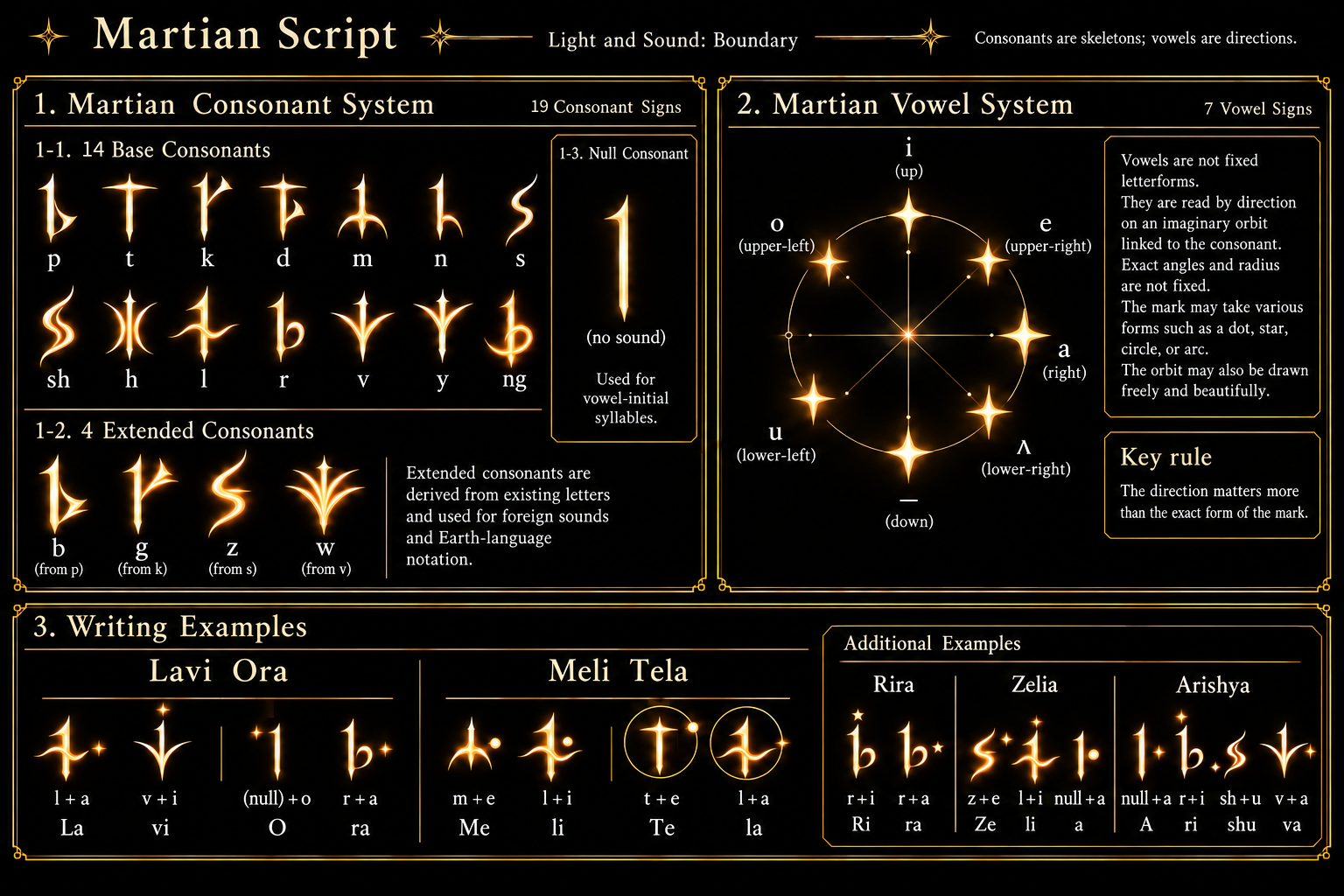
Martian Script Ver. 2.0 is not based on memorizing fixed outlines. Consonants are identified by essential forms and structural relationships; vowels are identified by direction.

14Core Consonants
4 + 14 Extended + 1 Empty Consonant
7Basic vowels defined by direction
Core principle: the forms shown in official charts are reference forms. Every character may be freely decorated and transformed as long as the essential form, direction, position, and structural relationships that define its identity are preserved.
Consonants

Read consonants by form

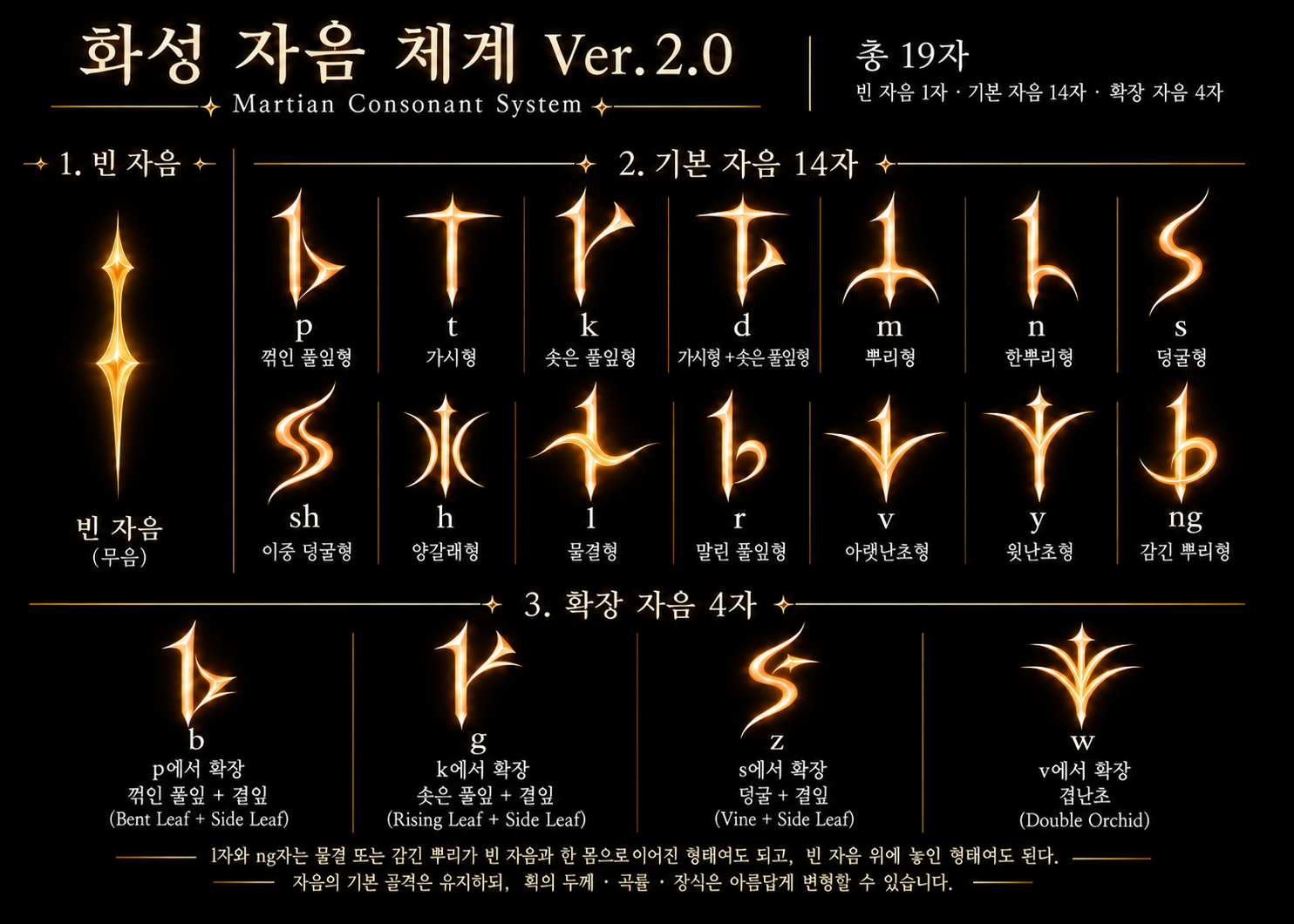
The system has 14 Core Consonants. b, g, z, and w are Extended Consonants derived from existing visual elements. The Empty Consonant provides the structural skeleton for vowel-initial syllables.

Martian Consonant System Ver. 2.0

Rising Leaf and Side Leaf

A Rising Leaf may be broad, thin, straight, diamond-shaped, or ornamental, provided that it retains the characteristic of rising upward at roughly 45 degrees.

A Side Leaf is a smaller auxiliary element extending horizontally or slightly upward and remains visually subsidiary to the Rising Leaf.

Codas

Codas exist, but there are no special coda letters. The same consonant skeleton is used without a vowel marker, and the coda retains its inherent consonantal value.

ŋ is a Core Consonant and is normally used in coda position in Martian.

Vowels

Read vowels by direction

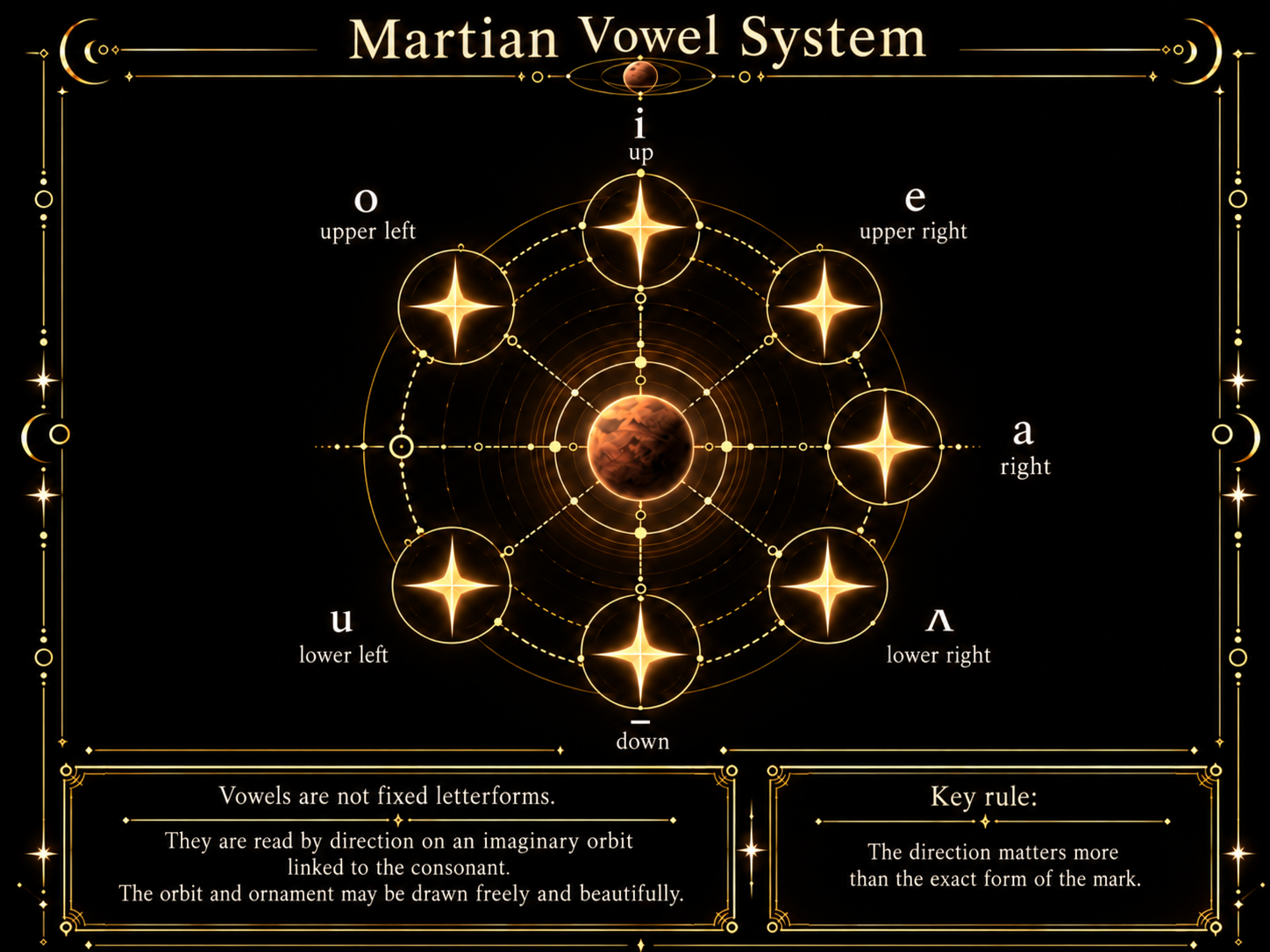
The value of a vowel is determined by its directional region relative to the consonant, not by the exact shape of its marker or orbit.

Martian Vowel System Ver. 2.0

a · e · i · o · u · − · ʌ

Starting with a at 3 o’clock and moving counterclockwise in intervals of about one hour and thirty minutes gives a → e → i → o → (9 o’clock left empty) → u → − → ʌ.

Why is 9 o’clock empty?

It provides structural spacing in horizontal writing. A marker directly to the left of a character could collide with the right-side elements of the preceding character, while upper and lower directions interfere less with neighboring characters.

The orbit is not the vowel. The direction is the vowel. Orbits may be circular, elliptical, polygonal, open, free-form, or omitted entirely when the direction is clear.
Compound Vowels

Multiple directions, optional ordering

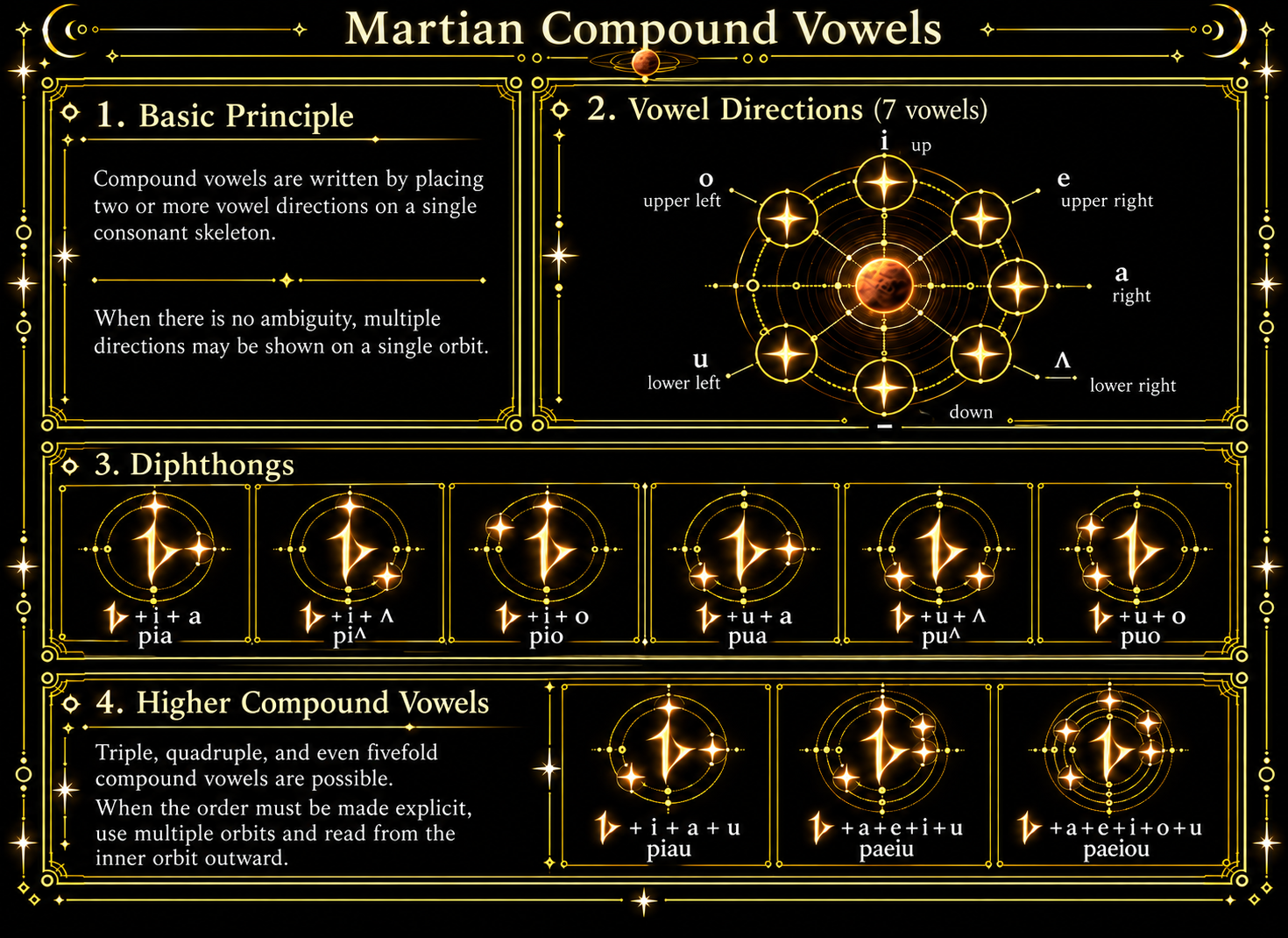
Two or more vowels may function together as one unit. Multiple markers may share one orbit when order is clear; when pronunciation order must be explicit, different radii may be used.

Martian Script Compound Vowels
Direction determines vowel type; when necessary, orbit radius determines pronunciation order. When multiple radii are used, read inner → outer.
Y / W Duality

Consonant–Vowel Duality of Y and W

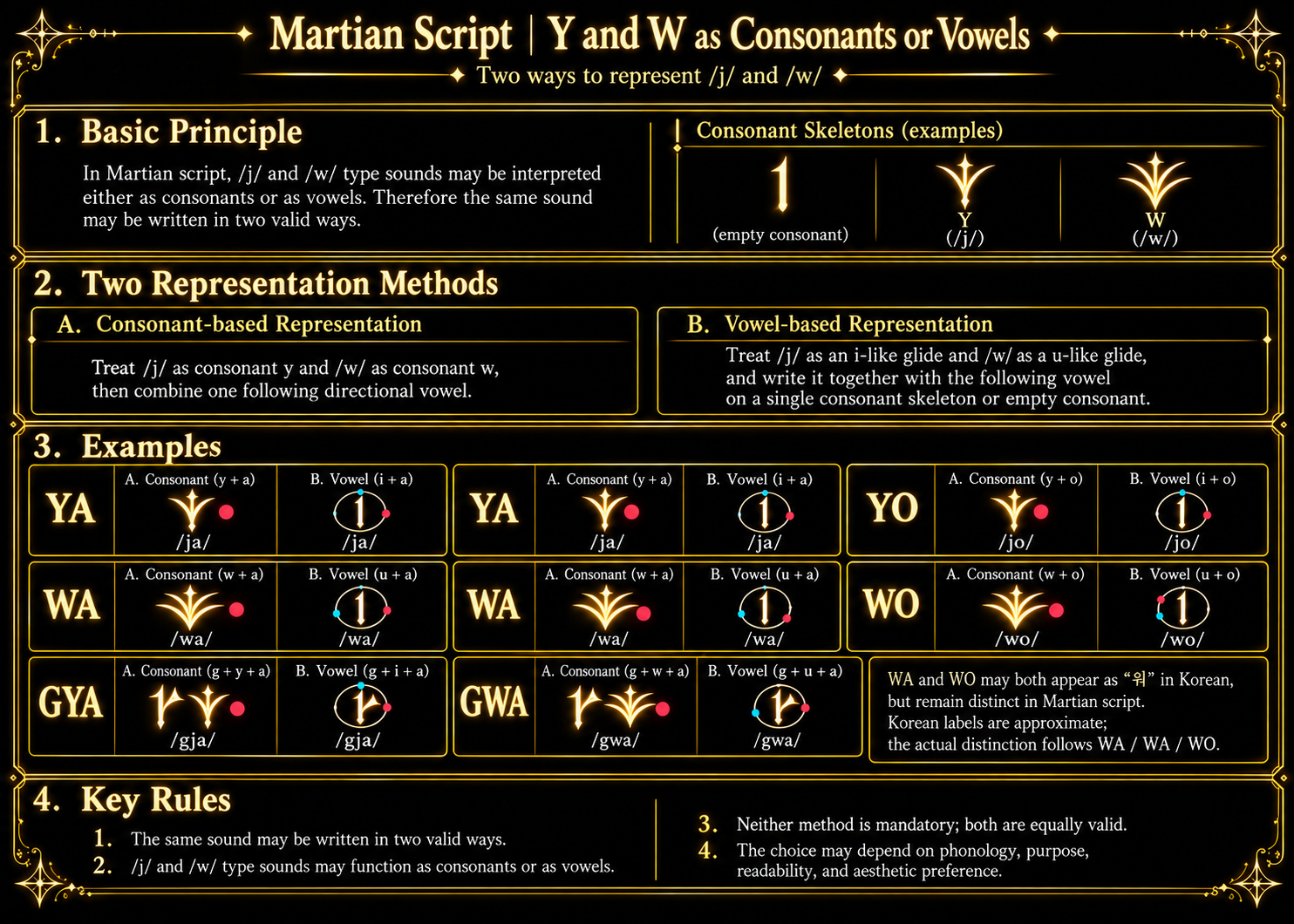
Y-like and W-like sounds may be represented either as consonants or as part of a vowel or compound-vowel structure. More than one valid spelling may therefore exist for the same pronunciation.

Consonant Vowel Duality of Y and W
Non-Martian Phonetic Extension Set

Extend by phonetic value, not spelling

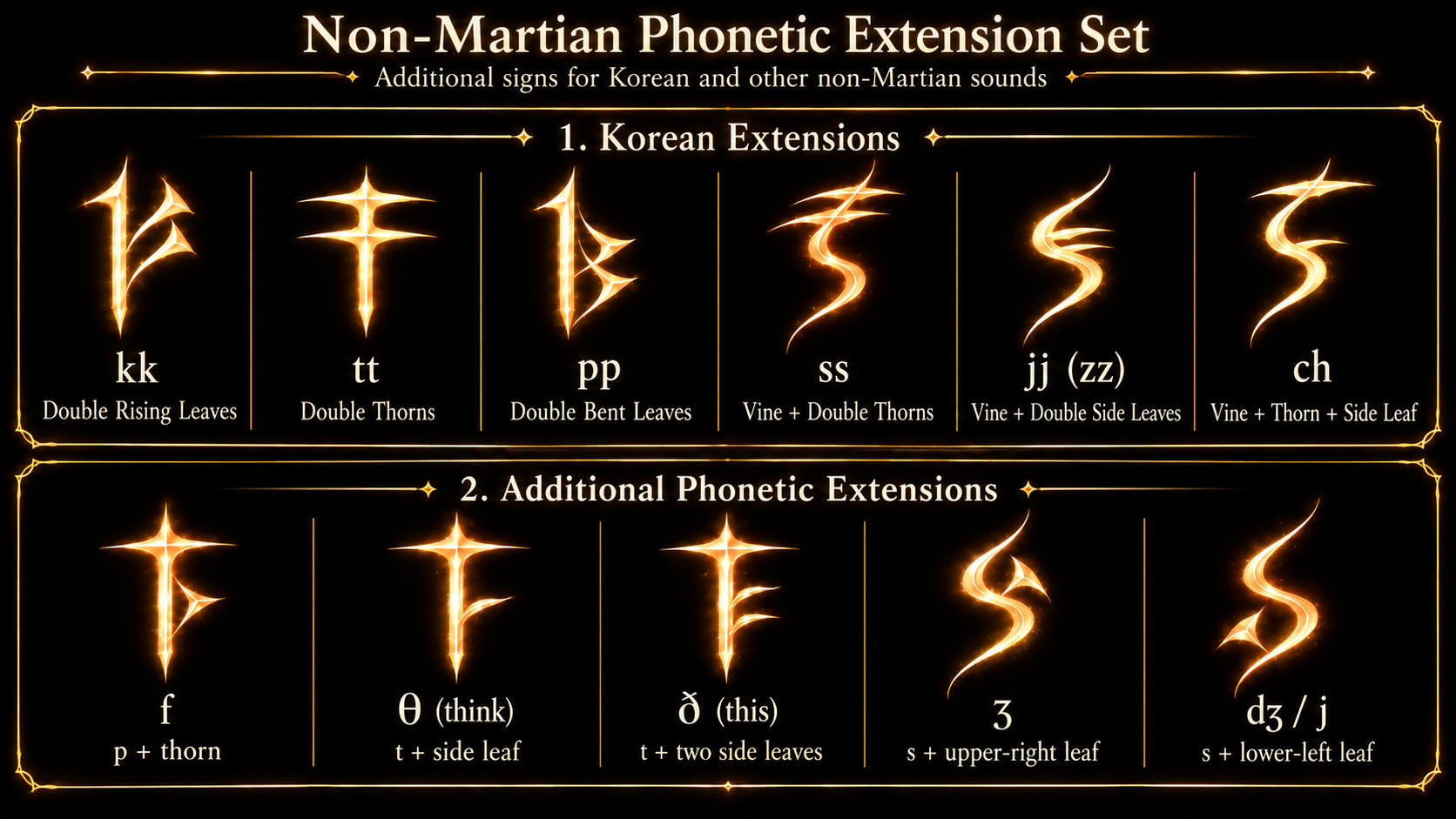
When another language requires sounds that do not exist in Martian, new signs can be built from the existing visual vocabulary of the script. The extension belongs to a phonetic value, not exclusively to one Earth language.

Non-Martian Phonetic Extension Set

Shared across languages

If different languages use the same sound category, they may share the same extension character. For example, ch represents the /tʃ/ category and may also be used for Korean ㅊ.

Different sounds remain distinct

/z/, /ʒ/, and /dʒ/ are distinct phonetic values and use distinct forms. Likewise, English th represents both /θ/ and /ð/, which are kept separate in Martian Script.

From Script to Language

From characters to songs and stories

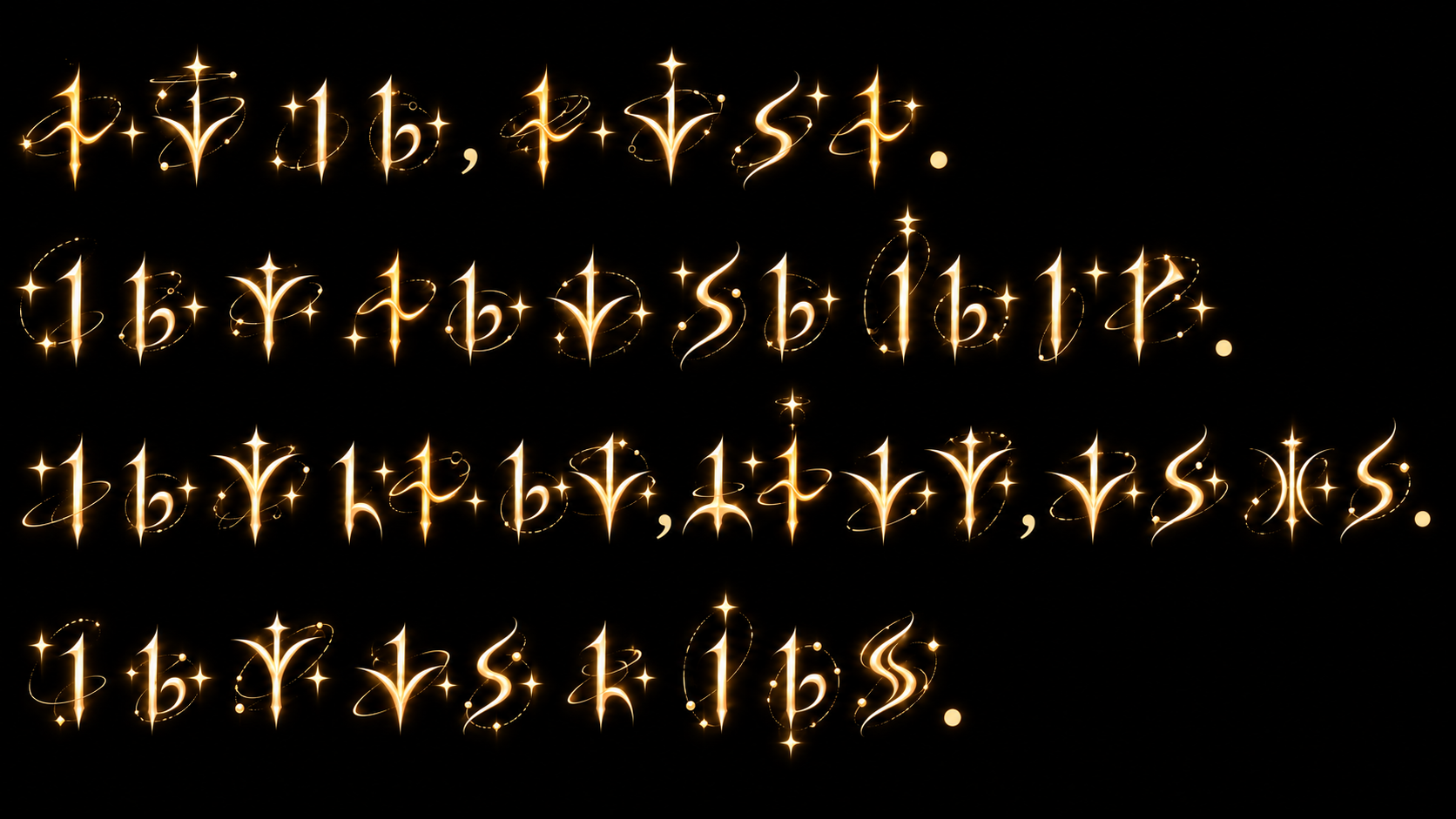
The Martian Script was created to write, sing, and tell stories in the Martian language. Lavi Ora and the stylized Zelia inscription are examples of the script in actual creative use.

Zelia in Martian ScriptLavi Ora in Martian Script
Lavi Ora
Zelia Goes on Air
EP1 Crown
Official Rules

Complete specification in PDF

This webpage is an accessible overview of the structure and central principles of Ver. 2.0. The complete rules cover definitions, codas and resyllabification, compound vowels, stylistic freedom, and Non-Martian phonetic extensions.

Official Martian Script Rules Ver. 2.0

Official creation date: October 6, 2026 · Ver. 2.0 established: October 15, 2026

⬌ Kmall.com
greatunion@naver.com